 Stack to Orbit
About
How a rocket works, built and flown in 3D
Stack to Orbit is a free, interactive explainer of a modern two-stage launch vehicle modelled on the Vulcan Centaur. You assemble the rocket on the pad one part at a time, read what each piece does, then launch it and follow the flight all the way to a satellite in orbit.
It is made for anyone curious about spaceflight: students, teachers, launch watchers, or anyone who has seen a liftoff on TV and wondered what all the pieces are for. It runs in the browser on a computer, tablet or phone, with nothing to install.
How to use it
- Build. Go through eight build steps, starting from the launch pad: the orange first stage booster, two BE-4 engines, strap-on solid rocket boosters (pick zero, two, four or six), the interstage, the Centaur V upper stage, the payload and the fairing.
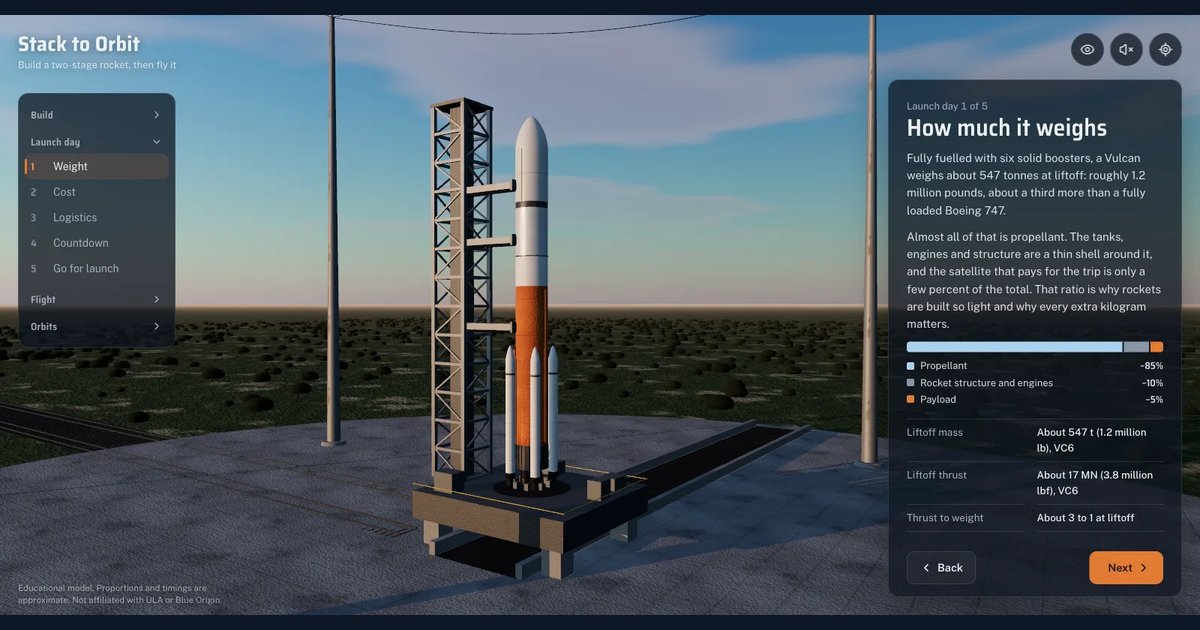
- Launch day. See how much the rocket weighs, what a launch costs, how the parts get to the pad, how the countdown runs, and what has to be go before liftoff.
- Fly. Press launch and follow nine flight events: liftoff, Max-Q, solid booster jettison, booster engine cutoff, stage separation, fairing jettison, orbit insertion, payload separation and solar arrays deploying. A clock shows altitude and speed throughout.
- Explore orbits. Compare low Earth, sun-synchronous, medium Earth, geostationary transfer and geostationary orbits, and see why satellites eventually come down.
Drag to look around and scroll or pinch to zoom. The eye button lets you see inside the shells to the engines and tanks underneath.
How it is made
The rocket, pad and satellite are 3D models built in code with three.js. Their textures are generated in the browser as the page loads, the engine plumes and smoke are custom shaders, and the engine rumble is synthesized live. Earth uses NASA-derived surface maps. The figures in the text are rounded public numbers for the Vulcan Centaur family.
Questions
Why do rockets have more than one stage?
Most of a rocket's weight is propellant, around 85 percent at liftoff. Once the first stage has burned its share, its empty tanks and engines are dead weight. Dropping them lets the lighter upper stage keep accelerating to orbital speed. You can watch this happen at stage separation.
What are the white boosters on the side for?
They are solid rocket boosters. They add a lot of thrust for about the first 90 seconds, but once lit they cannot be throttled or shut off. They burn out and are jettisoned. Vulcan flies with zero, two, four or six depending on the mission.
Why is the first stage orange?
The orange is spray-on foam insulation. The propellants are extremely cold, around -160 °C for the methane and -183 °C for the liquid oxygen, and the foam keeps them from boiling off and stops ice forming on the outside.
How much does a rocket launch cost?
Prices are not published, but a Vulcan launch is generally estimated at roughly $100 million to over $200 million. Nothing on it is reused yet, so every flight builds a new vehicle.
Is it accurate?
It is an educational model. Proportions and timings are approximate, and it simplifies a real flight to make each step clear. It is not affiliated with ULA or Blue Origin.
Ready to build one?
Open Stack to Orbit